“She doesn’t deserve to be alive” — this is how my late grandmother “complimented” Nigella Lawson.
And why does she not deserve life?
“Well look at her, she’s beautiful, she’s rich, she’s smart, she’s an amazing cook, and did it all with with kids. No one should have all that.”
I think this all the time. David Heinemeier Hansson doesn’t deserve to be alive either for instance — he makes millions of dollars at his bootstrapped, profitable, beloved business, he’s honored by geeks for creating Ruby on Rails, he’s a New York Times best-selling author and a race car driver, and all this with a 30-hour work-week.
Or James Altucher, who has lunches with people like Stephen Dubner (Freakonomics), writes like Penelope Trunk, appears on CNBC to talk finance, and manages to be funny and poignant and inspirational even while writing daily.
Of course they all do deserve to be alive, and deserve their success. And when it happens to you, it doesn’t work at all like you think it will.
The general reaction after I sold Smart Bear was that it somehow meant that now I’m “successful.” Was I not while I was building it? Was I not 4 months prior to selling it, before an offer came but I was the same person and Smart Bear was the same company? What about selling the previous company? What about raising my child?
What about this blog? That’s a good one because I’ve got subjective stories and objective data. In the past six months the tenor of the comments and email from strangers has changed. In response to an innocuous opinion piece about whether new top-level domain names are useful or wasteful, I hoped for and expected counter-arguments. I even expected people to skim, decide (incorrectly) that I was arguing a different point, and then attack that straw man with righteous indignation. That’s right, get it alllll out of your system. But what I didn’t expect was this:
“… These bloggers think they should dictate policy just because they have subscribers.”
At first I was full of indignation myself. I typed out a predictable, defensive, childish retort, full of stuff like “it’s an opinion” and “if you would bother to actually read to the end instead of assuming what I meant, you’d know that I do not in fact want policy to change, but just for people to think.”
Wah wah wah.
I didn’t send it; what’s the point? Such things only make those people angrier, and never convinces them.
Social media usually isn’t a debate, it’s a combination rotary club and soap box.
What did change my perspective was the bit about being “popular blogger.” I liked that part!
That title never makes sense to me. I still remember having 51 so-called subscribers, knowing full well half were blog directories and half of the rest were family members or Smart Bear employees who probably felt it was their duty. I remember scouring the latest posts on other blogs to scratch out a comment insightful enough to raise the eyebrow of a potential new reader, deftly slipping in a link to a relevant post of mine, baiting the hook that might catch another precious subscriber.

A year later and with slower-than-expected growth in subscribership, I decided that reaching the goal of a thousands subscribers was impossible, and “gave up” blogging, by which I mean I gave up trying to follow the “rules” of blogging as described by other bloggers who wrote about blogging. (Talk about the social media echo chamber!)
Of course, that worked. Here’s some tactics for blogging that I stumbled into, and my Ignite Austin presentation (5 minute video) about the broader lessons I learned.
At 1000 subscribers I should have felt like a success — when viewed from 51 it sure seemed like it would feel that way. But although it was fun to pass that threshold (and to install the FeedBurner counter which still lingers today at top-right), it wasn’t actually anything. It was an arbitrary invisible boundary, like turning 30 or the US debt ceiling (we can raise it 70 times but not 71?).
It’s a milestone by convention only.
So nothing changed, and I blew by 2000, 3000, and still nothing changed, except eventually I made the healthy decision to stop watching the counter so obsessively. And still nothing changed. (Which proves that was healthy.)
At the time of this writing, 50,000 more people have clicked “subscribe” than “unsubscribe.” And somewhere between then and now, I got a tattoo invisible to me but obvious to others that I’m a “popular blogger who thinks he has the right to…” I think it’s still the healthy thing to ignore that and just keep going. I refuse to accept some new responsibility, e.g. “careful what you say because people might hear it.”
Careful my ass. Nothing’s different. My opinions are still just opinions, based on my experiences, just as valid or invalid as ever. There’s more RT’s and HackerNews up-votes, more constructive comments and more vitriol, but it’s still just me thinking aloud.
50,000 RSS subscribers doesn’t make you happy either, by the way. Money doesn’t make you happy. Neither does selling a company, getting funding, or knocking something off your bucket list. You knew that already, right? That all this striving doesn’t automatically bring happiness? That even if you’re so successful that you don’t deserve to be alive, you’re not necessarily happy?
Maybe that’s how Altucher feels, and why he can’t stop creating. Probably, given the content of his blog. Maybe that’s how DHH feels, though it’s harder to tell with his minimalist, impersonal writing. Maybe that’s why Jobs couldn’t stop. And maybe Jobs demonstrates that this state of affairs is OK, that the lack of a finish line is what drives us, makes us interesting, gives us a reason not just to get up in the morning (the urge to pee is enough for that) but a reason to strive and live.
It’s why an entrepreneur is often a serial entrepreneur. I started my fourth company for the same reason that I started my first — because it’s a compulsion even when it’s unhealthy or wrong, like a momma hamster eating her young.
You could say “the journey is the reward” and “it’s a lifelong love of learning,” but although that might be true, it’s just alliteration. That’s not really why we do it. It’s because it’s a compulsion.
In fact, “success” is in fact often coupled with unexpected sadness.
Depeche Mode set out to do the impossible in 1988, playing a concert at the Rose Bowl. The media predicted an embarrassment, playing to a massive, largely empty stadium. They sold out all 60,000 seats. Backstage after the show, having achieved literally the pinnacle of their career, the band cried. As lead singer Dave Gahan said in an interview (my emphasis):
That was defying all the odds and, you know, people were whispering, “They’re never gonna fill this place,” and that kind of stuff. You could feel it but, at the same time, I had a real confidence that it was gonna be just fine and it turned out really well. And at the same time, see, a lot of those high points then become real low points as well afterwards, because what do you do to top that?
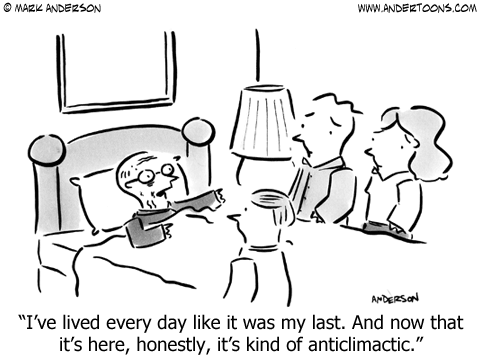
That’s the problem with “success.” After so many years of climbing your mountain, it’s not until you reach the top that you realize the next step is down. And the next mountains after that are lower.
What could DHH do that would surpass the thrill of creating Rails or hitting the New York Times best-seller list?
What if there isn’t a next thing?
Nevermind. Back to work…